
In today’s digital-first world, data and AI modernization is no longer optional — it’s essential. Organizations are rapidly transforming legacy systems into scalable, AI-ready platforms. One of the most effective enablers of this transformation is Swagger-driven API frameworks, built on the OpenAPI specification.
Swagger provides a standardized, clear, and machine-readable way to design, document, and manage APIs, making it a critical foundation for modern data and AI ecosystems.
“Design is the fundamental soul of a human-made creation that ends up expressing itself in successive outer layers of the product or service.”
-Steve Jobs-

What Is a Swagger-Driven API Framework?
A Swagger-driven API framework uses OpenAPI (Swagger) specifications as the single source of truth for API design. Instead of building APIs first and documenting later, developers define APIs upfront using Swagger, ensuring consistency, clarity, and automation across the entire development lifecycle.
This approach significantly improves collaboration between developers, data engineers, AI teams, and business stakeholders.
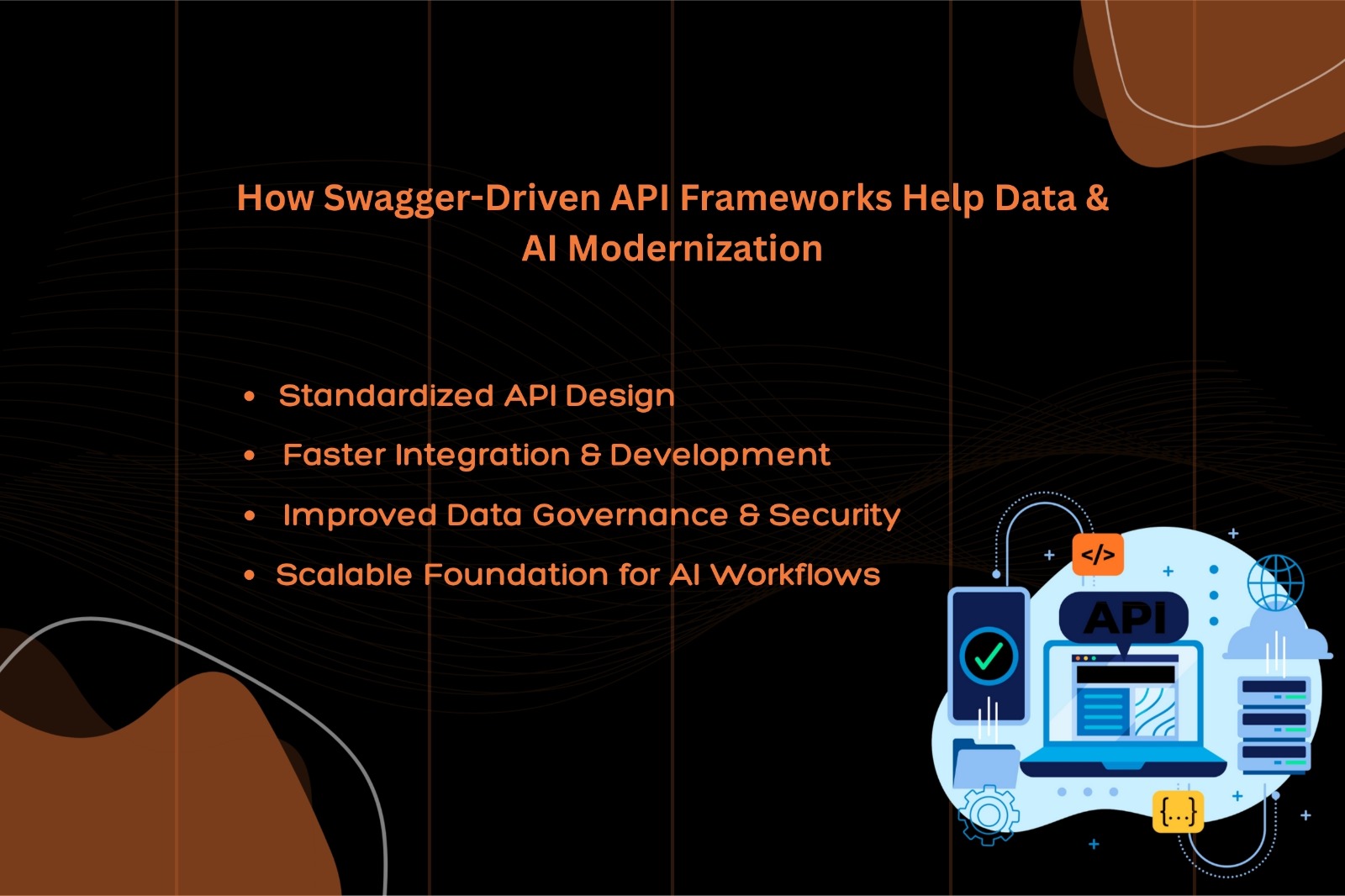
Standardized API Design
Swagger promotes consistent and standardized API design across teams and platforms. Every endpoint, request, and response follows a clear structure defined in the OpenAPI specification.
Benefits:
- Reduces ambiguity between frontend, backend, and data teams
- Improves API reliability and maintainability
- Makes APIs easier to understand, reuse, and scale
Standardization is especially important when APIs serve as data pipelines for AI models and analytics platforms.
Faster Integration & Development
Swagger-driven frameworks enable automatic code generation, interactive documentation, and API testing tools.
How this accelerates development:
- Frontend and AI teams can start working before backend implementation
- Faster onboarding for new developers
- Reduced development and integration time
- Fewer communication gaps and errors
This speed is critical when building data-driven and AI-powered applications that evolve rapidly.
Improved Data Governance & Security
Modern data systems demand strong governance and security controls. Swagger helps enforce them directly at the API level.
Key advantages:
- Clearly defined data contracts and schemas
- Easier implementation of authentication and authorization
- Better compliance with data policies and regulations
- Reduced risk of data misuse or leakage
For AI systems that rely on sensitive or large-scale data, secure APIs are non-negotiable.
Scalable Foundation for AI Workflows
AI workflows depend on reliable, scalable, and well-documented data access. Swagger-driven APIs provide exactly that.
Why it matters for AI:
- Consistent data access for model training and inference
- Easy integration with ML pipelines and cloud services
- Simplified scaling as data volume and AI usage grow
- Faster experimentation and deployment of AI models
APIs become the backbone connecting data sources, AI models, and applications.
Why Swagger Matters for Modern Enterprises
Swagger-driven API frameworks bridge the gap between legacy systems and modern AI platforms. They enable organizations to modernize incrementally without disrupting existing systems.
Whether you’re building:
- AI-powered applications
- Data analytics platforms
- Microservices architectures
- Cloud-native systems
Swagger provides the structure and flexibility needed for long-term success.
Final Thoughts
Swagger-driven API frameworks are more than just documentation tools — they are strategic enablers for data and AI modernization. By standardizing API design, speeding up development, strengthening security, and supporting scalable AI workflows, Swagger helps organizations build future-ready digital platforms.
If you’re planning to modernize your data architecture or integrate AI into your systems, starting with a Swagger-driven API strategy is a smart move.

0 Comments