

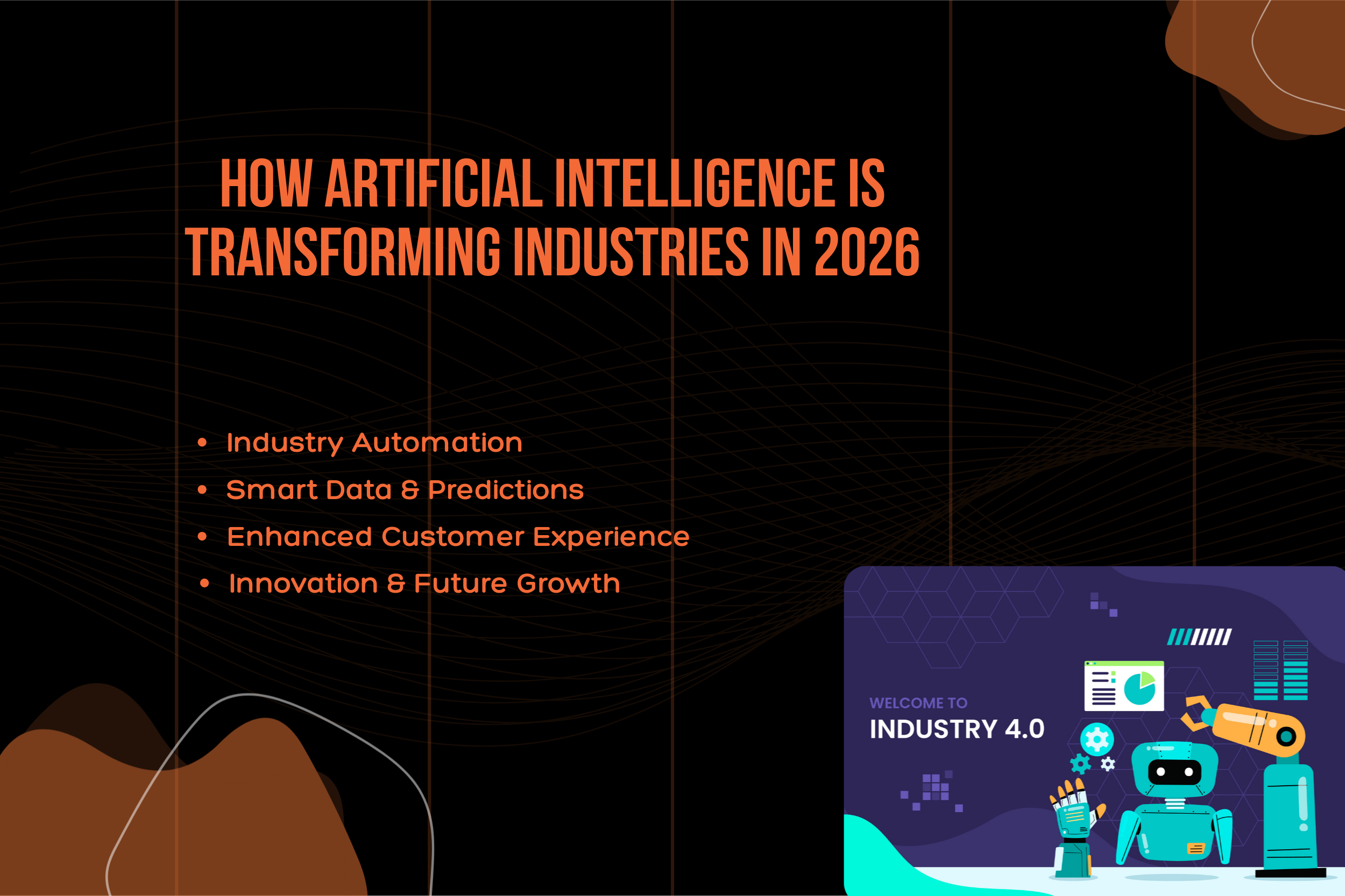
In recent years, Artificial Intelligence has evolved from a futuristic concept into a powerful force reshaping industries worldwide. By 2026, AI is no longer optional—it has become a core part of business strategy, helping companies improve efficiency, reduce costs, and deliver exceptional customer experiences.
From automation to predictive analytics, AI is driving a new era of innovation across sectors like healthcare, finance, retail, manufacturing, and more.
“Design is the fundamental soul of a human-made creation that ends up expressing itself in successive outer layers of the product or service.”
-Steve Jobs-

Industry Automation: Redefining Workflows
One of the biggest impacts of AI is automation. Businesses are using AI-powered tools to handle repetitive and time-consuming tasks, allowing employees to focus on more strategic work.
Key Benefits of Automation:
- Faster operations with minimal human intervention
- Reduced operational costs
- Improved accuracy and fewer errors
- 24/7 productivity
For example, in manufacturing, AI-driven robots can assemble products with precision, while in customer support, chatbots can handle thousands of queries simultaneously.
Automation is not about replacing humans—it’s about enhancing human capabilities.
Smart Data & Predictions: Power of Insights
Data is the backbone of modern businesses, and AI helps unlock its full potential through predictive analytics.
Using techniques like Machine Learning, companies can:
- Analyze massive datasets in seconds
- Predict customer behavior
- Forecast market trends
- Make data-driven decisions
Real-World Applications:
- Retail businesses predicting customer buying patterns
- Financial institutions detecting fraud in real-time
- Healthcare providers diagnosing diseases earlier
AI transforms raw data into actionable insights, giving companies a competitive edge.
Enhanced Customer Experience
Customer expectations are higher than ever, and AI is helping businesses meet—and exceed—them.
With AI, companies can deliver:
- Personalized recommendations
- Instant customer support via chatbots
- Voice assistants and smart interactions
- Seamless omnichannel experiences
Platforms like Amazon and Netflix use AI to recommend products and content tailored to individual users.
Why It Matters:
Better customer experience leads to:
- Higher engagement
- Increased customer loyalty
- Improved conversion rates
Innovation & Future Growth
AI is not just improving existing systems—it’s enabling entirely new business models.
Technologies like Natural Language Processing and computer vision are opening doors to innovations such as:
- Self-driving vehicles
- Smart cities
- AI-powered healthcare diagnostics
- Advanced cybersecurity systems
Startups and enterprises alike are leveraging AI to innovate faster and scale globally.
AI Across Major Industries
1. Healthcare
AI is helping doctors diagnose diseases faster and more accurately, improving patient outcomes.
2. Finance
Banks use AI for fraud detection, risk analysis, and automated trading.
3. Retail & E-commerce
AI enhances personalization, inventory management, and customer targeting.
4. Manufacturing
Smart factories powered by AI improve production efficiency and reduce downtime.
5. Education
AI enables personalized learning experiences and intelligent tutoring systems.
Challenges of AI Adoption
Despite its benefits, AI comes with challenges:
- Data privacy concerns
- High implementation costs
- Need for skilled professionals
- Ethical considerations
Businesses must address these challenges to fully leverage AI’s potential.
The Future of AI in Business
By 2026 and beyond, AI will continue to evolve, becoming more advanced, accessible, and integrated into everyday operations.
Companies that adopt AI early will:
- Stay ahead of competitors
- Innovate faster
- Deliver better customer experiences
AI is not just a trend—it’s a transformation.
Conclusion
Artificial Intelligence is revolutionizing industries by enabling automation, enhancing decision-making, and improving customer experiences. As technology continues to advance, businesses must embrace AI to stay relevant and competitive in the digital age.
The future belongs to those who innovate—and AI is leading the way.

0 Comments