

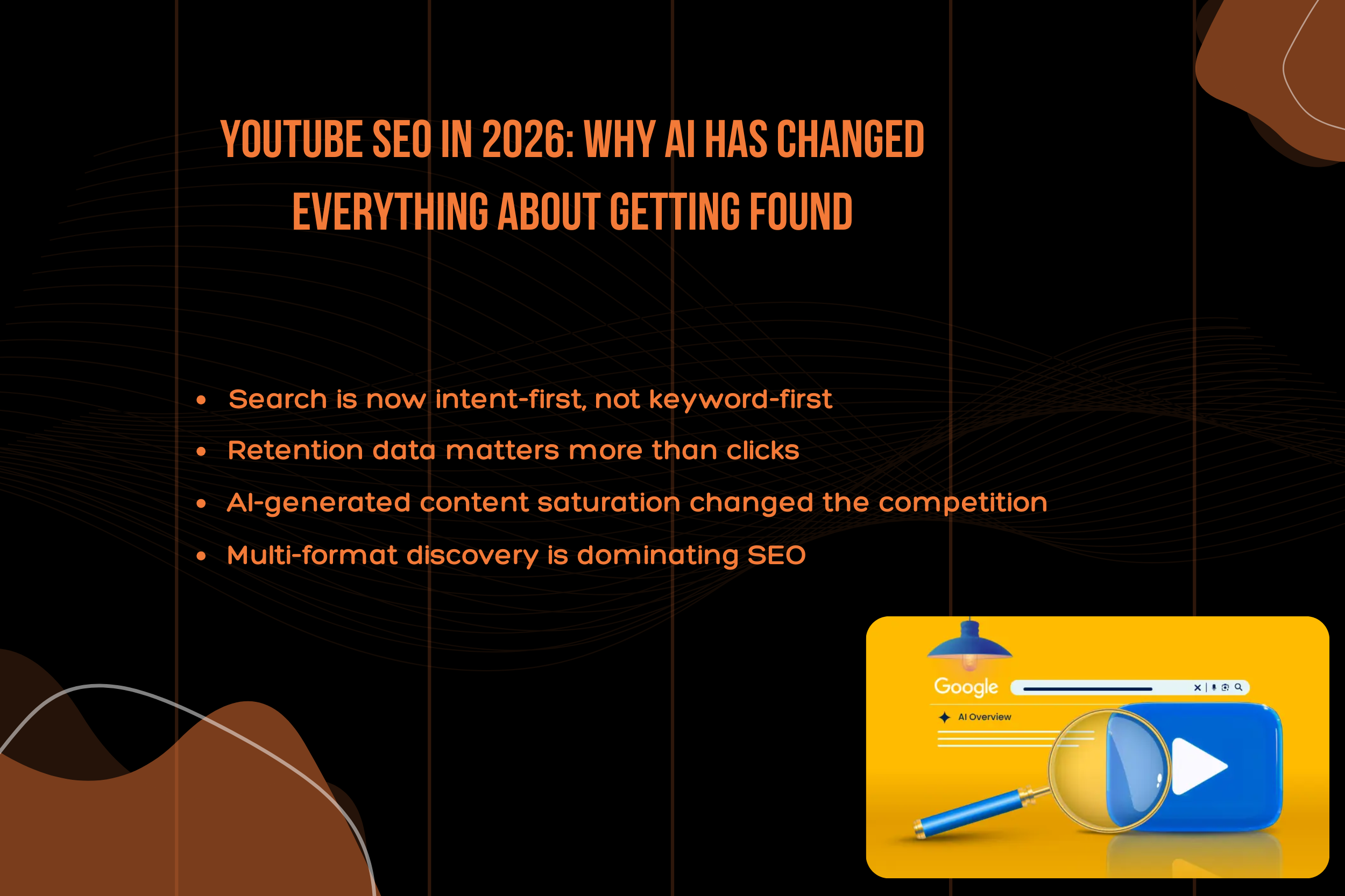
YouTube SEO in 2026 is no longer just about adding keywords in titles and descriptions. The platform has evolved into an AI-powered discovery engine where user intent, audience retention, engagement patterns, and content quality matter more than traditional optimization tricks.
With millions of AI-generated videos being uploaded every day, creators and brands must now focus on delivering authentic, high-retention, multi-format content that genuinely solves user problems. If you still rely only on old-school keyword stuffing, your videos will struggle to rank.
In this guide, we’ll explain how YouTube SEO works in 2026, what changed because of AI, and how creators can adapt to stay visible and grow faster.
“Design is the fundamental soul of a human-made creation that ends up expressing itself in successive outer layers of the product or service.”
-Steve Jobs-

1. Search Is Now Intent-First, Not Keyword-First
Earlier, creators could rank videos simply by repeating exact keywords in titles, tags, and descriptions. In 2026, YouTube’s AI understands context, search intent, audience behavior, and topic relevance far better.
For example:
- “Best camera for YouTube beginners”
- “Affordable vlogging setup”
- “Starter YouTube camera”
All of these may now trigger similar results because YouTube understands the intent behind the search.
What This Means for Creators
Instead of focusing only on keywords, focus on:
- Solving specific problems
- Answering user questions clearly
- Creating topic-focused content clusters
- Improving viewer satisfaction
SEO Tip
Use conversational titles that match how people naturally search.
Example:
- ❌ “YouTube Camera Cheap Best”
- ✅ “Best Budget Cameras for New YouTubers in 2026”
2. Retention Data Matters More Than Clicks
Getting clicks is no longer enough. YouTube now prioritizes videos that keep viewers watching.
If users click your video but leave after 20 seconds, your rankings will drop over time. High audience retention signals that your content is valuable and engaging.
Important Retention Metrics
- Average view duration
- Watch time
- Viewer satisfaction
- Returning viewers
- Session duration
How to Improve Retention
- Start with a strong hook in the first 10 seconds
- Remove unnecessary intros
- Use fast pacing and visual changes
- Add pattern interrupts
- Deliver value quickly
Pro Tip
Your thumbnail and title should accurately match the content. Clickbait may increase CTR temporarily, but poor retention hurts long-term rankings.
3. AI-Generated Content Saturation Changed the Competition
AI tools have made content creation easier than ever. Thousands of videos can now be created in minutes using AI voiceovers, scripts, and automated editing.
As a result, YouTube’s algorithm is increasingly rewarding:
- Original insights
- Human storytelling
- Personal experience
- Authenticity
- Expertise
Generic AI-generated videos without personality are becoming harder to rank.
What Works in 2026
Creators who combine AI efficiency with human creativity are winning.
Use AI for:
- Research
- Script ideas
- Editing assistance
- SEO optimization
But keep:
- Your voice
- Your experience
- Your unique opinions
- Real examples
4. Multi-Format Discovery Is Dominating SEO
YouTube is no longer just a long-form video platform.
Discovery now happens through:
- Shorts
- Long-form videos
- Community posts
- Podcasts
- Search results
- Google AI Overviews
- Recommended feeds
A single topic can perform across multiple formats.
Smart Strategy
Turn one content idea into:
- 1 long-form video
- 3–5 Shorts
- A blog post
- Social media clips
- Community updates
This increases visibility across multiple discovery systems.
5. Thumbnails and CTR Still Matter
Even with AI-driven search improvements, thumbnails remain one of the strongest ranking factors.
A strong thumbnail can dramatically improve:
- Click-through rate
- Impressions
- Watch time growth
Best Thumbnail Practices in 2026
- Use high contrast colors
- Keep text minimal
- Focus on emotion
- Make the subject clear
- Avoid clutter
Mobile optimization is extremely important because most YouTube traffic now comes from mobile devices.
6. Voice Search and AI Assistants Are Influencing Rankings
More users now discover content through:
- Voice assistants
- AI search tools
- Smart TVs
- Conversational search
This means creators should optimize for natural language questions.
Examples
Instead of:
- “YouTube SEO Tips”
Use:
- “How do small YouTubers grow faster in 2026?”
- “What helps videos rank on YouTube now?”
These conversational phrases align better with modern AI-powered search behavior.
7. Topic Authority Is More Important Than Viral Videos
YouTube increasingly rewards channels that consistently cover related topics.
If your channel focuses on:
- YouTube growth
- Content strategy
- Video editing
Then YouTube sees you as an authority in that niche.
Build Topical Authority By
- Creating content series
- Covering related subtopics
- Linking videos together
- Using playlists strategically
Consistency builds trust with both viewers and the algorithm.
8. Engagement Signals Continue to Matter
Likes, comments, shares, saves, and subscriptions still influence visibility.
However, YouTube now focuses more on meaningful engagement rather than spam interactions.
Encourage Real Engagement
Ask viewers:
- Questions
- Opinions
- Experiences
- Feedback
This creates stronger community signals.
Final Thoughts
YouTube SEO in 2026 is driven by AI, user intent, retention, and content quality. The creators who succeed are not the ones gaming the algorithm — they are the ones creating valuable, engaging, and authentic experiences for viewers.
To grow on YouTube today, focus on:
- Audience satisfaction
- Watch time
- Consistency
- Topic authority
- Multi-format content
- Human-first storytelling
AI has changed the rules, but it has also created massive opportunities for creators who adapt quickly.
If you build content for humans first and optimize intelligently, YouTube SEO in 2026 can become your biggest growth engine.

0 Comments