

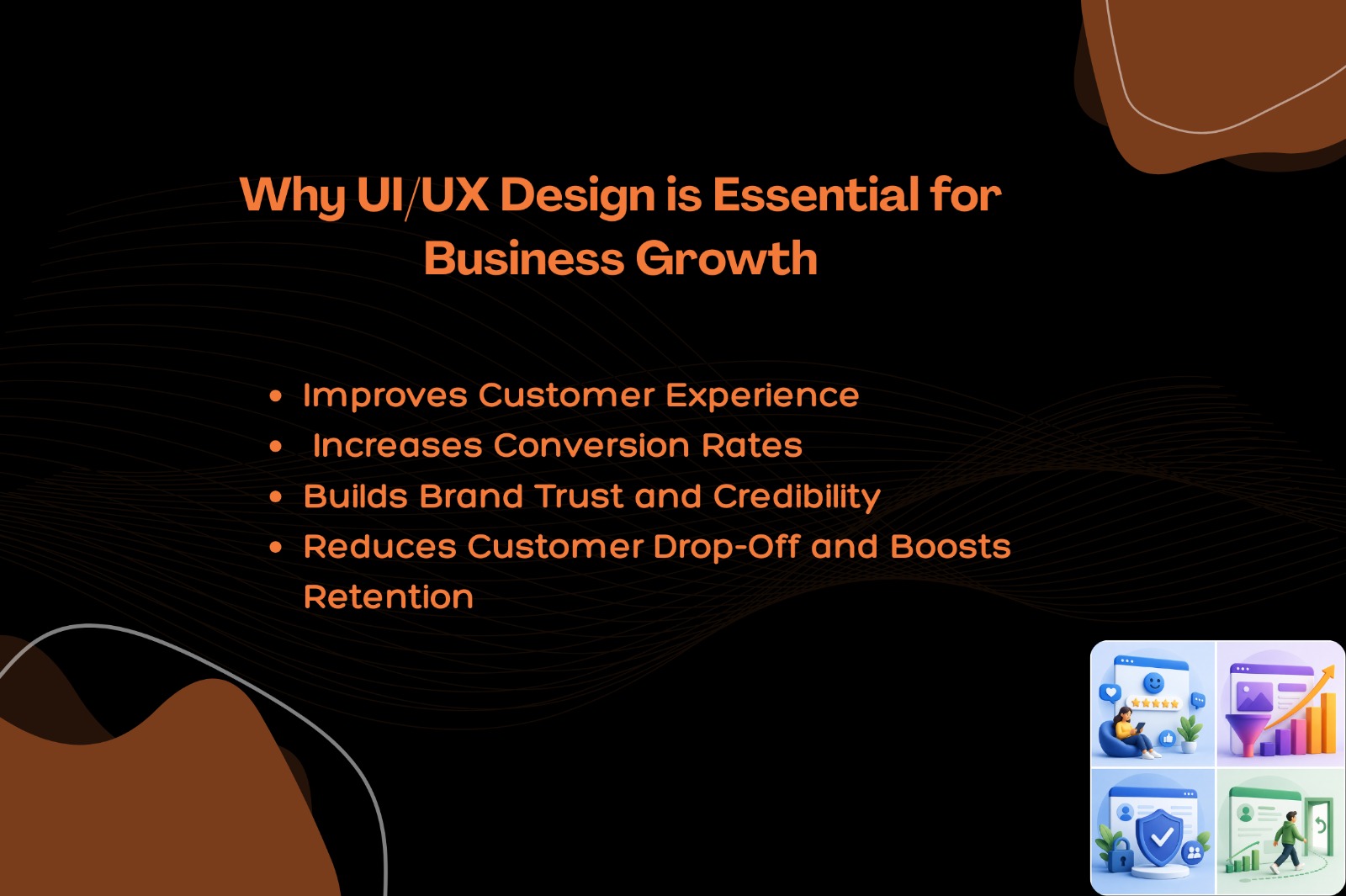
In today’s digital-first world, having a website or mobile application is no longer enough. Businesses need to provide a seamless, engaging, and user-friendly experience to attract, convert, and retain customers. This is where UI (User Interface) and UX (User Experience) design play a crucial role. A well-designed digital platform not only looks visually appealing but also ensures that users can easily navigate, interact, and achieve their goals without frustration.
Whether you are running an e-commerce store, a corporate website, a SaaS platform, or a mobile application, investing in UI/UX design can directly impact customer satisfaction, brand reputation, and overall business growth.
div class=”blockquote”>“Design is the fundamental soul of a human-made creation that ends up expressing itself in successive outer layers of the product or service.”
-Steve Jobs-

1. Improves Customer Experience
Customer experience is one of the most important factors influencing purchasing decisions. Users expect websites and applications to be intuitive, fast, and easy to use. If visitors struggle to find information, navigate pages, or complete actions, they are likely to leave and look for alternatives.
Effective UI/UX design focuses on understanding user behavior and creating interfaces that simplify interactions. Clear navigation menus, logical page structures, readable typography, and responsive layouts contribute to a positive experience. When users enjoy interacting with your platform, they are more likely to stay longer, engage with your content, and become loyal customers.
Benefits:
- Easier navigation and usability
- Reduced user frustration
- Higher engagement rates
- Improved customer satisfaction
- Better user retention
2. Increases Conversion Rates
A beautifully designed website means little if it fails to convert visitors into customers. UI/UX design plays a significant role in guiding users through the customer journey and encouraging desired actions.
Strategic placement of call-to-action buttons, simplified forms, intuitive checkout processes, and clear visual hierarchies help users make decisions faster. By reducing obstacles and creating a smooth user journey, businesses can significantly improve conversion rates.
For example, an optimized e-commerce checkout process can reduce cart abandonment, while a user-friendly landing page can generate more leads and inquiries.
Conversion Benefits:
- Higher lead generation
- Increased online sales
- Reduced cart abandonment
- Improved form completion rates
- Better ROI from marketing campaigns
3. Builds Brand Trust and Credibility
First impressions matter. Studies show that users form opinions about a website within seconds of visiting it. A professional and modern design immediately creates trust and confidence, while a cluttered or outdated interface can drive potential customers away.
Strong UI design ensures consistency in colors, typography, imagery, and branding elements across all digital touchpoints. Consistent branding reinforces professionalism and makes your business appear more reliable and trustworthy.
When users feel confident in your brand, they are more likely to engage with your services, make purchases, and recommend your business to others.
Trust-Building Elements:
- Consistent branding
- Professional visual design
- Clear communication
- Transparent user journeys
- Secure and reliable interactions
4. Reduces Customer Drop-Off and Boosts Retention
Many businesses lose potential customers because their websites or apps are difficult to use. Slow loading pages, confusing navigation, and complicated processes often result in high bounce rates and customer drop-offs.
UX design focuses on identifying pain points and eliminating barriers that prevent users from completing their goals. By continuously improving usability and performance, businesses can keep customers engaged and encourage repeat visits.
Retaining existing customers is often more cost-effective than acquiring new ones. A positive user experience increases customer loyalty and encourages long-term relationships with your brand.
Retention Advantages:
- Lower bounce rates
- Increased session duration
- Higher customer loyalty
- More repeat purchases
- Stronger customer relationships
5. Enhances Mobile User Experience
With a significant percentage of internet traffic coming from smartphones and tablets, mobile-friendly design has become essential. Users expect websites and applications to function flawlessly across all devices.
Responsive UI/UX design ensures that content adapts to different screen sizes while maintaining usability and visual appeal. Mobile optimization improves accessibility, engagement, and overall customer satisfaction.
Mobile Design Benefits:
- Better user experience on all devices
- Improved mobile conversions
- Increased engagement
- Higher search engine rankings
- Wider audience reach
6. Supports SEO and Online Visibility
Search engines prioritize websites that provide excellent user experiences. Factors such as page speed, mobile responsiveness, user engagement, and navigation structure influence search rankings.
Good UX design helps improve these metrics, making your website more attractive to search engines. A well-optimized user experience can lead to higher rankings, increased organic traffic, and better online visibility.
SEO Advantages:
- Faster page loading times
- Improved mobile performance
- Better user engagement signals
- Lower bounce rates
- Increased organic traffic
7. Creates a Competitive Advantage
In competitive markets, user experience can be the deciding factor between your business and your competitors. Customers are more likely to choose a platform that is easy to use and visually appealing.
Investing in UI/UX design allows businesses to stand out by delivering memorable experiences that competitors may overlook. A superior user experience can become a key differentiator that drives customer preference and loyalty.
Competitive Benefits:
- Stronger market positioning
- Improved customer perception
- Greater customer loyalty
- Higher conversion rates
- Increased business growth opportunities
Best Practices for Effective UI/UX Design
To maximize business growth through UI/UX design, consider the following best practices:
✔ Understand your target audience
✔ Prioritize simplicity and usability
✔ Maintain consistent branding
✔ Optimize for mobile devices
✔ Improve website speed and performance
✔ Use clear calls-to-action (CTAs)
✔ Conduct regular user testing
✔ Analyze user behavior and feedback
✔ Focus on accessibility and inclusivity
✔ Continuously update and improve designs
Conclusion
UI/UX design is much more than visual aesthetics—it is a strategic business investment that directly impacts customer satisfaction, conversion rates, brand credibility, and long-term growth. A well-designed digital experience helps businesses attract new customers, retain existing ones, and build a strong competitive advantage in today’s digital landscape.
As consumer expectations continue to rise, companies that prioritize UI/UX design will be better positioned to create meaningful customer experiences, drive engagement, and achieve sustainable business success. Investing in user-centered design today can lead to higher revenue, stronger customer loyalty, and significant business growth in the future.

0 Comments